
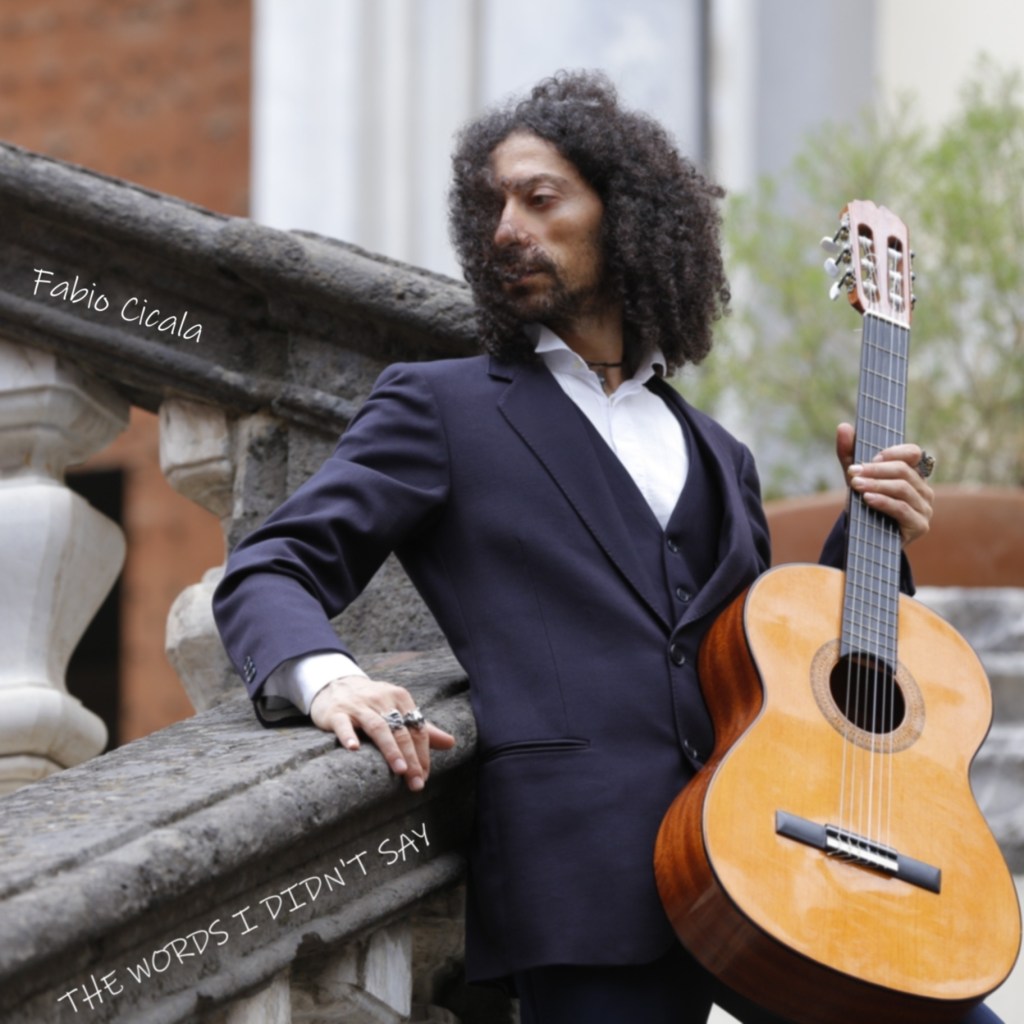
In an era where music often feels disposable, Fabio Cicala’s The Words I Didn’t Say stands out as a deeply personal and evocative composition, showcasing not just technical prowess but a raw, emotional depth that lingers with the listener long after the final note fades.
Cicala, a London-based guitarist and composer originally from Italy, has poured his heart and soul into this track, blending baroque and neoclassical elements with the free-spirited essence of ‘70s progressive rock. The result? A hauntingly beautiful piece that transcends genre, inviting listeners into a space of contemplation and introspection.
Recorded at two of the world’s most prestigious studios—Abbey Road and Soho Sonic Studios—The Words I Didn’t Say benefits from an impeccable sonic quality. But it’s not just about where it was recorded; it’s about how it was crafted. Cicala’s choice of instrument, a Cordoba F7 Paco, serves as an extension of his soul, delivering intricate, virtuoso phrasing with a finesse that demands attention. The sensitivity of the microphones picked up even the subtlest nuances—every breath, every shift in pressure on the strings—adding to the organic, almost meditative nature of the track.
At the heart of The Words I Didn’t Say lies a poignant story. Inspired by a fleeting yet powerful connection on a film set, Cicala channels his emotions into a melody that weaves through longing, restraint, and self-reflection. The track is a testament to the complexity of human emotion—how we navigate attraction, commitment, and the paths we choose to walk. Instead of a traditional love song, it feels like an ode to personal growth, a philosophical musing on fate and the choices we make.

Musically, the composition is as dynamic as the emotions it captures. The intricate, fast-paced chromatic changes and psychedelic undertones nod to the legacy of progressive rock, while the delicate harmonization and hypnotic soundscapes offer a meditative quality. Cicala’s ability to marry technical brilliance with raw feeling is what makes this track truly stand out.
Beyond this single, The Words I Didn’t Say is part of a larger nine-song project recorded between 2019 and 2020. Titled Rude Awakening, the collection serves as a sonic diary of Cicala’s journey through self-discovery, featuring an eclectic mix of styles all tuned to 432 Hz—believed by some to be a frequency that promotes relaxation and healing. The project’s name is fitting, as it encapsulates that defining moment of awakening that propels one toward transformation.
Though primarily focused on growing his online presence at the moment, Cicala is no stranger to live performance. His history as a London street performer, playing corporate events, and even appearing in films like Artemis Fowl (where he played a busker elf) only adds to his artistic mystique. Whether on-screen or through his music, his dedication to storytelling remains unwavering.
This is not just another instrumental track—it’s an experience, a meditation, and an open invitation to journey through sound and self-reflection.
Want to dive deeper into Fabio Cicala’s artistic journey? Read our exclusive interview where he shares insights into his creative process, inspirations, and the deeper meanings behind The Words I Didn’t Say!
The Words I Didn’t Say blends baroque, neoclassical, and progressive rock influences. How did you merge these styles while keeping your unique identity as an artist?
I’ve always loved listening to well structured music, rich of chromatic transitions. Furthermore, since I’m mostly a self taught musician, I think this helps me keep an unprejudiced attitude towards music composition. For this song in particular, I sought effectiveness in the minimal use of notes, so that they could highlight the chord changes with simplicity. The best way to achieve such result, it seemed to me to be a combination of arpeggios and chords, on melodic minor scales. The riff, or the “ostinato” in classical jargon, has a baroque feel, in a style also widely used in neoclassical heavy metal, a genre that I appreciate very much. Then though, the song sounded very dramatic, so at some point I thought to add a more lively element, made of chords transitions used in progressive rock. The choice of styles has been perfect to tell, intricacies of the backstory of the song.
Your classical guitar, the Cordoba F7 Paco, plays a central role in this track. What makes this instrument special to you, and how does it shape your sound?
I went to buy this guitar just a few days before my first recording, and while I was looking around to see which one most spoke to me, I saw her, on a stand over the carpet, especially lighted from a window. It felt like the universe was directing me to her! Then I discovered the making was inspired by grand master Paco de Lucía, one of my guitar heroes, and her sound was very warm… The back and the sides are made of rosewood, while the top is in cedar, and the binding is in maple, which make a very agile and versatile guitar, perfect for my playing throughout the whole spectrum of the sound! I prefer D’Addario Pro Arte nylon strings for the crispy sound and the feeling in my fingers.
You’ve described this song as a reflection of your personal and spiritual journey. What emotions or lessons from your path are embedded in the music?
This song is about a love at first sight, or if you prefer, a crush on someone, which may be perceived like a twin flame or a soul mate. But it shows a different perspective on the subject. I’ve always had a great respect for love, so I thought to share the topic of a propitious idyll not acted on, as a way to build a stronger commitment to the special someone we chose to walk through life with! If you want to think of a more general lesson embedded in the song, that would be reinforcing our resilience to avoid a distraction, in order to preserve our long-term goals.
The song was inspired by a moment of self-restraint and stoicism. How did turning this experience into music help you process those emotions?
Music has always been a way for me to heal from the sickness of the world. Like many of my songs, transmuting my emotions into music, has helped me to detach from them and to see the bigger picture. In this case, it showed me the advantages of not to give in to the fear of missing out when I’m already committed to someone.
The melody for The Words I Didn’t Say started as an impromptu neoclassical solo while playing Careless Whisper. What other unexpected moments have sparked your songwriting?
When I realized the song was sounding very dramatic, the image of the pathos and resilience of Ulysses navigating through the Mediterranean sea, particularly around the mermaids came to my mind. He ordered to be tied to the mainmast, while his crew would have had put wax in their ears, not looking at him while navigating among the mermaids, and be focused on the sailing. This is how the progressive rock influence contributed to the melody.
You believe that we attract the right people and opportunities based on our mindset. How has this philosophy influenced your music career?
Someone said “the universe reveals its secrets to those who dare to follow their hearts”. Actually, since when I started to take music seriously once I moved to the UK, more often than not, my life has been filled with synchronicities in line with my mindset. For example, once I was walking on the streets after a jam session, and I was thinking how lovely would have been playing the guitar more often, in an environment which would have given me the motivation to do just that… And I saw an advertisement on the window of a restaurant saying “looking for a solo guitarist”! I walked in and spoke to the manager, who told me to come the following Saturday for a trial. I got the job, and every week I went to play for one night at the restaurant. The customers started to like me, so the nights became two, then three, and finally, four per week! This very experience, made me very confident in my playing and I started to write my own songs. Another time I got out of the underground, while I was thinking how cool would have been to be a busker in London: I stopped by a great pianist playing on the streets, who gave me the hints to be able to busk legally in The City. A few months later I was a busker myself! There are zillion more experiences like them which I could tell you about. But is also true we need to trust the timing of our lives… I’ve been willing to take singing lessons for years, but only last year, I finally managed to start working with a vocal coach to hone my voice. So, at the end of the day, I feel relaxed, like the universe got me covered, as long as I do my inner work and carry on practicing!
Recording at Abbey Road Studios and Soho Sonic Studios is a dream for many artists. What was the most unforgettable moment from those sessions?
I have a vivid memory of my experience in these studios! I felt spoiled by the technicians and the stuff, which made sure I was comfortable in my sessions. There was a crowd of people taking photos and filming whoever walked in and out from the Abbey Road Studios, and finally, it’s hard not to think about the mystic energy of the premises, which boosted my self-confidence, and gifted with the willing to create something unique. All of this, lead me to improvise in my compositions, and you can still hear some unplanned sounds in some of them!
Since the recording was stripped down to just classical guitar, what challenges did you face in conveying the depth of emotion in the track?
The main challenge, is probably to make the composition effective, to find musical solutions which at the same time don’t even waste a note, but are able to develop the chromatic transitions, and let the listeners dream away along the melodic storytelling. But I think it’s a great way to explore my favourite “naked” sounds, before wanting to create relationships among different musical instruments!
You’ve performed as a busker, played special events, and even appeared in films. How have these experiences shaped your approach to music?
When you busk in the streets, especially in a city like London that moves very fast, you have to continually outdo yourself with more and more intense songs, and a strong scenic presence. Busking has taught me how to grab the attention of passers-by in a few seconds, how to find the right way to look them in the eye, in a country where this type of contact doesn’t come as easy as in southern Italy… Playing in restaurants has taught me how to be discreet without lowering the music standard, since music may not always be the main attraction there, but you still need to play well, as the guests notice everything, even when it looks like they don’t! It goes without saying, when you play in a venue who has advertised your show, you have to give 100% as a performer and as a persona. Acting and working as a background artist, make me feel more laid back, because once you pass the audition, you can focus on your segment, and the production, the crew and the other members of the cast will do all the rest. The movie camera records every fragment of you, so a strong inner work is always necessary, but in a way, when I’m on a movie set, I learn to take myself less seriously, and I feel like a child again. In terms of sound and composition, performing in this megalopolis, both in the streets and in venues, has increased my curiosity toward unfamiliar musical genres and traditions, to be able to relate to people coming from different cultural backgrounds. Working in films, helps me tap into my inner child, that, among other things, comes handy when composing, not to mention that makes me consider literally every sound as part of a music score!
The Words I Didn’t Say is part of a larger nine-song project. What can listeners expect from the rest of the collection?
My nine songs are my “sound diary”, and present fragments of different genres harmonized in minimal and vibrational sounds, at times hypnotic, a musical fabric that helps the listeners to relax and meditate.
This music project is called “Rude Awakening”, an experience we all go through at least once in our lifetime, when our lives suddenly change because of a bereavement, the loss of a job, moving abroad, etc. Such an experience is spiritually a “rude awakening”, but within the challenges, also come great opportunities, and this happens because we are pushed out of our comfort zone, and discover new skills and passions we didn’t know we had. For example, since emigrating, I started to take music seriously, and it has become my way to heal and to share my journey with the world, but I don’t know whether I would have done so, if I had stayed in Italy! Anyway, last year I released a song titled “Rude Awakening”, just like the name of the collection, that was even more minimal and hypnotic than “The Words I Didn’t Say”. The rest of the songs still come with the energy of personal and spiritual growth, but focus on different aspects of my life of a creative emigrated abroad, from the memory of the Italian city I feel more attached to, to the Greek mythology stories I’ve loved since when I was a child, and so on… Musically speaking, some songs develop over a jazz texture, some others have flamenco fragments, psychedelic vibes are vivid too, and other genres are featured as well.
The track is recorded in 432 Hz, a frequency known for its meditative qualities. How do you believe this tuning affects the listener’s experience?
Well, before the middle of last century, every composer had their own tuning preference, but 432 Hz was a common tuning frequency for classical and pop music accepted in all the Western world. At some point, there has been a conference where it was decided for a tuning with A 440 Hz, but it needs to be said this kind of tuning makes listeners very efficient in performing their everyday tasks, and less relaxed. So I guess everyone listening to my songs, will feel more attuned with themselves, and hopefully find their own pace when doing something!
 The Hollywood Six