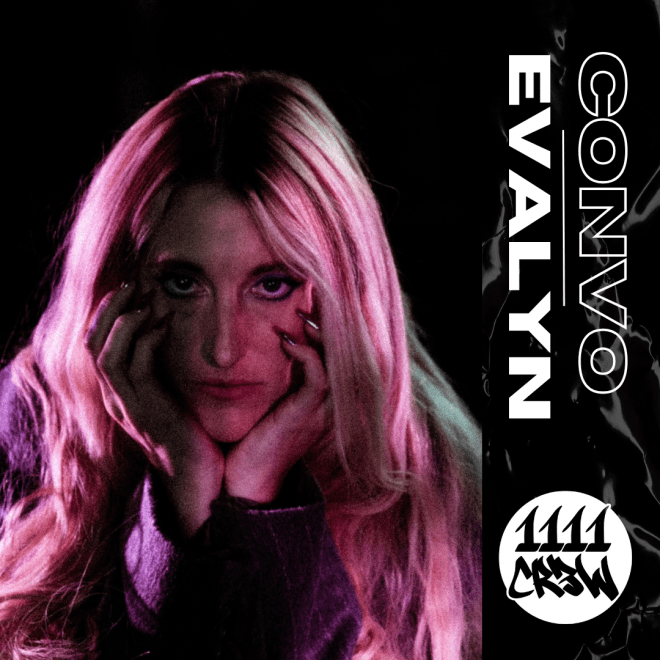
By the time Evalyn is crawling across the floor in pink tights and six months pregnant, there’s no mistaking it—she’s all in. It’s not just for show. It never has been. The Los Angeles-based artist, whose voice once set fire to dance floors on Louis the Child’s breakout hit “Fire,” returns this summer with “The Feeling”—a track that pulses like a live wire and signals the opening chapter of her most daring era yet.
The single is an ecstatic freefall—built on a bedrock of 2010s euphoria but cracked open by lived experience. It’s sweat-slick and neon-lit, packed with feverish basslines and surging hooks, yet it’s grounded in something rawer: the manic dance of instinct overtaking logic. “This song is really about being taken over by a feeling or a raw instinct,” Evalyn shares. “We wanted to create that through movement. I was six months pregnant and crawling on the floor in heels and pink tights—I think that helped capture the chaos.” That imagery isn’t just a detail—it’s the emotional centerpiece. It’s the kind of beautiful mess that can’t be faked.
Evalyn’s story has always been one of emotional extremes. She broke through with the dreamy psychedelia of Salvation in 2018, offering listeners a rare cocktail of vulnerability and transcendence. That record, now revived with new material in a 2024 vinyl reissue, became a touchstone for fans who wanted something more honest than escapism—something like truth set to a four-on-the-floor beat.
And now, A Quiet Life, her upcoming album, promises to dismantle any lingering boundaries between the dance floor and the divine. Written while her body and mind were metabolizing the chaos of pregnancy, the album turns inward even as it explodes outward. The influence of Aphex Twin, ARCA, and Grimes isn’t just sonic—it’s spiritual. The record moves like a strange dream, one moment intimate and hushed, the next brutal and dissonant, capturing a consciousness unraveling and reforming all at once.

Evalyn’s hero’s journey isn’t the typical music industry arc of hustle-to-headline. Hers is a more subterranean evolution: surviving personal turbulence, rewriting herself through sound, and daring to bring the audience with her. She doesn’t just sing about transformation—she lives it, stage by stage, album by album, scream by whisper.
In the world of dance-pop, where sheen often supersedes soul, Evalyn has become a subversive force—proof that pop can hold both glitter and grief. Her collaborations with names like Dillon Francis, RAC, and Jai Wolf put her at the center of electronic music’s most emotionally intelligent moments, while performances at Coachella, The Greek Theater, and CRSSD reveal a live energy that’s anything but manufactured. When Evalyn steps onstage, she brings every part of herself—the artist, the woman, the mother-to-be, the seeker.
That radical wholeness has earned her a devoted following and coverage in the media, not to mention over 130 million Spotify streams and placements across some of the platform’s most influential playlists. But what sets Evalyn apart isn’t reach—it’s resonance.
“The Feeling” is more than a single. It’s an entry point into the chaos and clarity of A Quiet Life, an album that doesn’t claim to have the answers but dares to ask better questions. How do you hold your identity as it shapeshifts? How do you stay grounded while surrendering to something larger than yourself?
For Evalyn, it seems, the answer is always movement—crawling, dancing, collapsing, rising again. And this time, she’s inviting the world to feel it all with her.
Section I: The Feeling – A Sonic Adrenaline Rush
1. “The Feeling” captures a kind of mania and euphoria—what inspired this track, sonically and emotionally?
Evalyn: Sonically, I was super inspired by the sounds of electro pop in the 2010s. I love the way that songs in that era made me feel and wanted to capture that euphoric energy. Emotionally, it is about letting go. That’s what most of this album has been about—letting go and letting the feeling lead the way.
2. You mentioned crawling on the floor in heels and pink tights while six months pregnant during the video shoot—can you talk about how pregnancy shaped both the song and its visual?
Evalyn: Yes! The intensity of working on the music and visuals and being pregnant made me push everything a little further. Pregnancy was such a raw and vulnerable experience and that affected every part of the creative process. Every overwhelming emotion I had, I poured back into the project.
3. The track draws from the euphoric sounds of the 2010s. Were there specific artists or songs from that era that shaped your creative direction?
Evalyn: Absolutely! I was obsessed with artists like Passion Pit, Matt & Kim, and Miiike Snow. I also loved the pop of that era like Icona Pop, Robyn, and La Roux. There was an unabashed feel to that music and I wanted to play with creating that electric quality through unique sound choices.
4. What was the biggest challenge or surprise while bringing “The Feeling” to life?
Evalyn: Well, it started as a completely different song with a disco feel, and the “don’t fight the feeling” part was something I ad-libbed as an idea for a bridge. We loved that line so much that we scrapped the rest of the song and made it the chorus. We let our imaginations run wild with the production, and that became the template for the rest of the album.
Section II: On A Quiet Life and Conceptual Depth
5. A Quiet Life is described as your most ambitious work, exploring themes of motherhood, anxiety, and transformation. How did becoming a mother reshape your artistic voice?
Evalyn: I was pregnant while working on this album. I felt really sick and uncomfortable for most of my pregnancy and was so nervous about having a baby. I poured all of those fears and feelings into the music. Becoming a mother has been so amazing, but the journey to get here has been trial by fire—and I think you hear that a lot in this album.
6. You reference the psychological chaos of modern life—endless scrolling, identity loss, etc. How do these themes play out across the album?
Evalyn: Yeah, I think pregnancy magnified this stuff, but in general I’ve been feeling it for a few years. It seems like the world is louder now and sometimes I can’t stop scrolling and staring at the phone or the TV. It turns my brain off, and it kind of freaks me out how addicting it can be. There’s anxiety in that, so the songs on the album are meant to capture that experience—they’re fast-paced with a lot of switch-ups because I wanted each song to sound like the feeling of life now, where we’re hearing and seeing so much constantly.
7. With production inspirations like Aphex Twin, ARCA, and Grimes, how did you balance experimental elements with the accessibility your fans love?
Evalyn: I write pop songs—my melodies and lyrics are always going to lean in that direction because it’s who I am and what I do and what I listen to. So in the studio I try and balance that with vocal and production choices that can really carve out a unique sound. The songs will have the pop sensibility my fans come to me for, but the way I dress them up is where I sculpt and morph them to mean something more.
8. The title A Quiet Life is intriguingly paradoxical given the chaos within. What does “a quiet life” mean to you, personally and artistically?
Evalyn: For the first time in my life, I was settling into a quieter way of life—getting married, finding a home, having a baby—but somehow the world seemed louder than ever. I felt like I was drowning in the internet and in fear and expectation. So this album was an exploration of the concept of a different kind of quiet life.
Section III: Evolution as an Artist
9. You’ve evolved from “Fire” with Louis the Child to this raw, visceral new chapter. How would you describe the throughline that connects these eras?
Evalyn: I love collaborating and working with other creatives. That’s the hallmark of my musical career. So from working with electronic artists I love, to other female writers and artists, to my own project—that sense of creating something with people I admire is the throughline.
10. Your music has always fused vulnerability with melody. Has your approach to songwriting changed over the years, or just deepened?
Evalyn: I like to think that as I’ve learned the rules, I’ve gotten better at breaking them. My songwriting is inherently just my voice and perspective, so it doesn’t really change—but I think my choices and influences do.
11. You’ve collaborated with so many innovators in the electronic space—what do you look for in a creative partner?
Evalyn: I think relating to collaborators on taste is super important. Otherwise, it comes down to any other form of relationship—if we get along as humans, we’ll probably make something cool together.
Section IV: Performance & Impact
12. You’ve performed everywhere from Coachella’s Sahara Tent to The Greek Theater—how do you translate such emotionally complex songs into live energy?
Evalyn: No matter the tempo or feel of the song, when you’re performing it on stage, you’re going to feel the energy coming off of the audience. I love to give that back to them by fully leaning into the adrenaline and the emotion.
13. Do you approach festival performances differently from more intimate sets, especially with your newer, more personal material?
Evalyn: Oh absolutely. Intimate performances are more like having dinner together—we get to talk and relate over the music. Bigger performances are like a party we’re at together, and this album is meant to be both the dinner date and the afters.
Section V: Mind, Body, and Art
14. You’re also studying clinical psychology and mindfulness—how does this side of your life influence your music, especially on A Quiet Life?
Evalyn: I got my master’s degree in Psychology during the pandemic! It was always something I wanted to do. I think it made me very introspective, haha, but it also gave me insight into how much of the human experience is shared even though we often feel alone. It’s a theme in the album for sure.
15. Do you see your music as a form of therapy—for yourself, your listeners, or both?
Evalyn: Making this album got me through the hardest moments in my pregnancy—the nausea, the anxiety. It also helped me capture the excitement and the nervous energy. So the music has been my therapy, and we’ll have to see if that translates to listeners.
Section VI: Looking Ahead
16. With “The Feeling” kicking off this new era, what can fans expect next from A Quiet Life in terms of sound and story arc?
Evalyn: You can expect things to get more intense and chaotic from here. You can dig deeper for the story—because there very much is one. Or you can just let yourself feel it sonically. But I wanted this album to be a full-blown rollercoaster, and I feel very confident that it is.
17. If this album is a permission slip to “feel everything loudly,” what’s one emotion or truth you hope listeners sit with most?
Evalyn: No one knows which way is up.
18. Is there a track on the album that was the hardest to write—but the most healing?
Evalyn: In Everything is the most important song to me on A Quiet Life. I wrote it about my baby and it is both healing and scary to put something so vulnerable out there.
 The Hollywood Six